As Japan continues to face structural labor shortages, human resources management has become more than an internal administrative function.
For small and medium-sized enterprises, startups, and foreign-led businesses operating in Japan, the ability to hire, retain, assign, evaluate, and manage people properly can directly determine whether the company can scale in a sustainable way.
According to Japan’s Ministry of Health, Labour and Welfare, 33.8% of university graduates who entered employment in March 2022 left their first employer within three years. The figure was even higher for high school graduates, at 37.9%. At the same time, a Reuters survey reported that 66% of Japanese companies said labor shortages were having a serious or fairly serious impact on their business operations.
HR management is not only about hiring more people. It is about building an organization that can keep people, allocate responsibilities clearly, control labor risks, and maintain operational stability as the business grows.
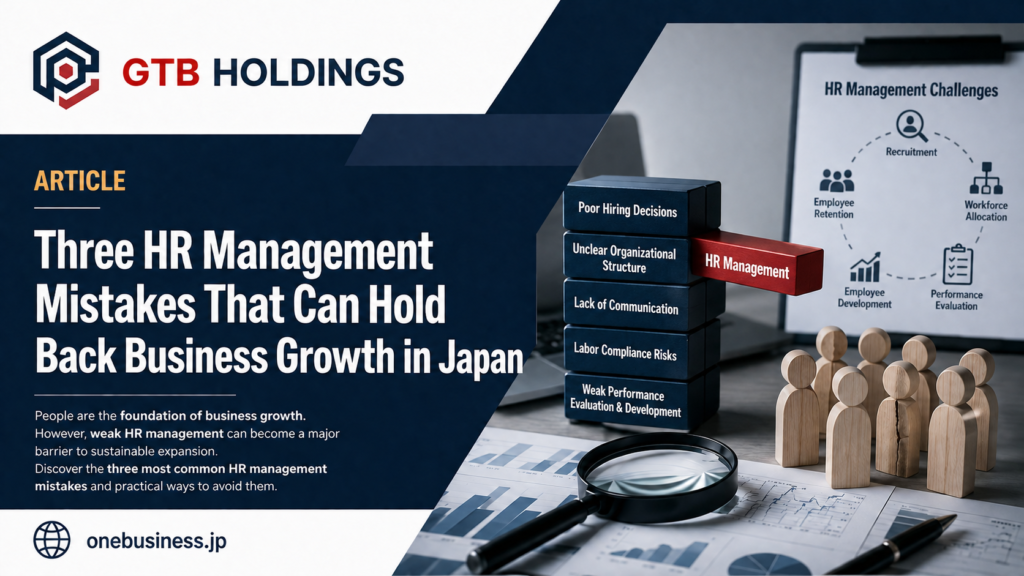
Below are three common HR management mistakes that companies in Japan should avoid.
1. Hiring Without Defining Roles, Responsibilities, and Expected Outcomes
The first mistake is hiring people before clearly defining what they are responsible for.
In many early-stage companies, recruitment begins with an urgent need: “We need someone to help,” “The team is overloaded,” or “We need more staff for daily operations.” However, if a new employee joins without a clear job description, reporting line, decision-making authority, and performance expectations, the organization can quickly become inefficient.
Tasks may overlap. Important responsibilities may be left unattended. Employees may assume that someone else is in charge. Managers may be forced to check every detail themselves. As a result, the company appears to have more manpower, but not necessarily more execution capacity.
Without a clear responsibility structure, growth can create confusion faster than revenue.
Employee turnover also carries a significant financial cost. Gallup estimates that the cost of replacing an employee can range from one-half to two times that employee’s annual salary.
For example, if an employee earns JPY 3.6 million per year, the real replacement cost may range from JPY 1.8 million to JPY 7.2 million when recruitment, onboarding, training, handover, lost productivity, and organizational disruption are taken into account.
2. Managing People Based on Personal Trust Instead of Data and Process
The second mistake is relying too heavily on personal impressions, informal communication, and individual trust.
In the early stage of a company, founders can often observe each employee directly. They know who is working hard, who is responsive, and who can be trusted. However, as the company grows, this style of management becomes increasingly unreliable.
Without regular work reports, task tracking, deadlines, performance criteria, error records, and documented communication, management cannot accurately identify who is producing results, who is overloaded, where work is delayed, or which problems are recurring.
This creates two major risks. High-performing employees may feel that their contribution is not properly recognized and eventually leave. At the same time, underperforming employees may remain in the organization because there is no objective basis for evaluation or improvement.
In Japan’s current labor market, where talent retention is already difficult, this lack of management visibility can weaken the entire organization.
Companies that manage people only through personal trust may remain flexible in the short term, but they often become unstable when the number of employees and business operations increase.
3. Neglecting Working Hours, Overtime, Workplace Conduct, and Labor Risk
The third mistake is treating labor compliance as a secondary issue.
In Japan, working hours, overtime, paid leave, workplace harassment, mental health, and employment documentation are all critical management areas.
Failure to manage these properly can lead not only to employee dissatisfaction, but also to legal, financial, and reputational risk.
Japan has seen several major cases that illustrate this point. The Dentsu overwork case became a national issue after a young employee’s death was recognized as karoshi, or death caused by overwork. The case led to renewed public debate over excessive overtime and corporate responsibility.
In another case, Yamato Holdings reviewed unpaid overtime issues across a large number of employees, showing how inadequate labor-time management can create large-scale financial exposure.
Recent data also highlights the seriousness of workplace mental health and harassment risks.
According to Japan’s Ministry of Health, Labour and Welfare, there were 1,055 workers’ compensation payment decisions related to mental disorders in fiscal 2024. Among them, 224 cases were related to power harassment by supervisors or others in the workplace.
HR management is not simply about employment contracts and payroll.
It also involves controlling working conditions, preventing excessive workload, maintaining a healthy workplace culture, and recording labor-related information properly.
HR Management Is a Growth Infrastructure
For companies operating in Japan, HR management should be viewed as business infrastructure.
A small company does not need to build a complex corporate system from the beginning. However, it does need a minimum structure: clear job descriptions, defined responsibility owners, work reporting, performance criteria, employment contracts, attendance management, leave rules, handover procedures, information access control, and an internal channel for reporting workplace issues.
The difference between a company that grows sustainably and one that becomes unmanageable is not determined only by product quality or sales capability. It is also determined by whether the company can build a system that allows people to work clearly, fairly, and safely.
In a market where labor shortages are becoming more serious and compliance expectations are rising, companies that manage people with structure and data will have a stronger foundation for long-term growth.
Companies that continue to rely only on personal relationships and informal management, on the other hand, may face higher turnover, labor disputes, data loss, operational inefficiency, and weakened competitiveness over time.